The Apprentice Economist by Filip Palda
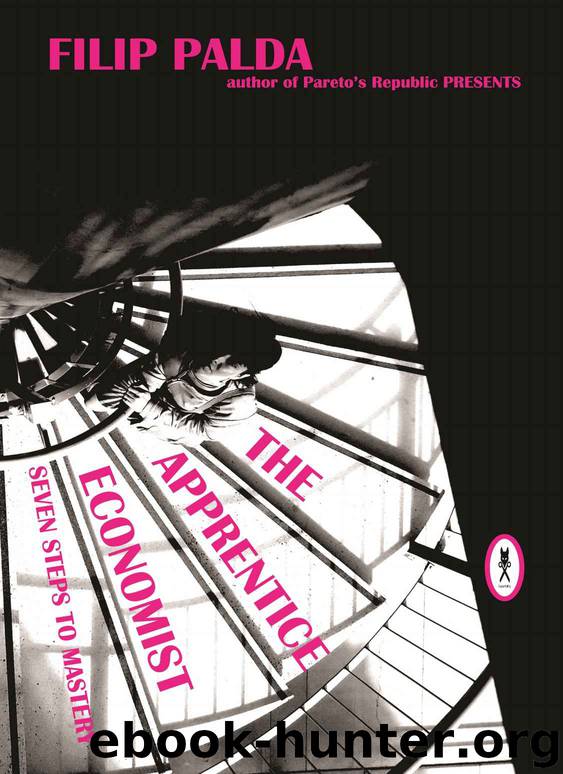
Author:Filip Palda
Language: eng
Format: mobi, epub
ISBN: 9780987788047
Publisher: Cooper Wolfling
Published: 2013-11-22T05:00:00+00:00
Curving economic space
ONE SUCH SURPRISING application arises in the labor market. Some jobs are about more than just wages. Workers are not simply selling their labor. They are also buying certain desirable on-the-job amenities such as child-care, comfortable parking, and cafeteria services. They “purchase” these amenities by providing employers with desirable qualifications and perhaps by accepting a wage that is below what they contribute to the company’s profits. The sales are “tied” because they are an inseparable part of working in the chosen firm.
One of the most studied aspects of tied labor market transactions is the value of on-the-job training for young, low-wage workers. In pre-industrial times apprentices valued this training so much that they paid their employers for the privilege of working the seven years it took to become certified in a trade. Even the young James Watt, later the inventor of the modern steam engine, trudged all over Scotland and England in a desperate attempt to find someone willing to train him in the trade of scientific tool-making. Today schools have assumed the task of teaching trades. Yet one can still detect an echo of this process in medicine, last of the surviving secretive medieval trade-protection organizations. Interns work like serfs in the expectation of princely salaries to follow.
Apprentices and budding physicians are not the only ones who benefit from on-the-job training. The same can be said of young, low-wage workers. Firms may be willing to take them on and train them up provided that they can be compensated for their efforts. Young workers will compete for jobs that teach general skills by offering their services at a wage sufficiently low to compensate employers for the learning experience. Finnis Welch wrote that “since workers can take the benefits of training with them when they leave for other employment, firms may have little incentive to offer training. But they can offer on-the-job training in exchange for lower wages” (1978, 31-32).
The reason such training is of necessity to a tied-sale is that not everything can be learned in the classroom. Sherwin Rosen explains that “It is a common observation that most specific job skills are learned from work activities themselves. Formal schooling complements these investments, both by setting down a body of general knowledge and principles for students as well as teaching them how to learn. But even in the case of professional training there is no perfect substitute for apprenticeship and for work experience itself” (1986, 677). There is no educational substitute for elbow grease.
Into this discussion, add the minimum wage. Few people, even few economists, associate this seemingly humanitarian government policy with worker training. Yet a bit of reflection clarifies that in the tied-sales environment of the workplace the minimum wage may rob workers of the chance to learn job skills that could raise them out of poverty. As Sherwin Rosen has explained,
An effective minimum wage puts a distinct ceiling on the worker’s ability to pay for on-the-job training, and this constraint is more binding the lower the
Download
This site does not store any files on its server. We only index and link to content provided by other sites. Please contact the content providers to delete copyright contents if any and email us, we'll remove relevant links or contents immediately.
International Integration of the Brazilian Economy by Elias C. Grivoyannis(111313)
The Radium Girls by Kate Moore(12090)
Turbulence by E. J. Noyes(8113)
Nudge - Improving Decisions about Health, Wealth, and Happiness by Thaler Sunstein(7758)
The Black Swan by Nassim Nicholas Taleb(7195)
Rich Dad Poor Dad by Robert T. Kiyosaki(6727)
Pioneering Portfolio Management by David F. Swensen(6341)
Man-made Catastrophes and Risk Information Concealment by Dmitry Chernov & Didier Sornette(6138)
Zero to One by Peter Thiel(5863)
Secrecy World by Jake Bernstein(4795)
Millionaire: The Philanderer, Gambler, and Duelist Who Invented Modern Finance by Janet Gleeson(4538)
The Age of Surveillance Capitalism by Shoshana Zuboff(4352)
Skin in the Game by Nassim Nicholas Taleb(4306)
The Money Culture by Michael Lewis(4266)
Bullshit Jobs by David Graeber(4249)
Skin in the Game: Hidden Asymmetries in Daily Life by Nassim Nicholas Taleb(4051)
The Dhandho Investor by Mohnish Pabrai(3825)
The Wisdom of Finance by Mihir Desai(3788)
Blockchain Basics by Daniel Drescher(3623)
